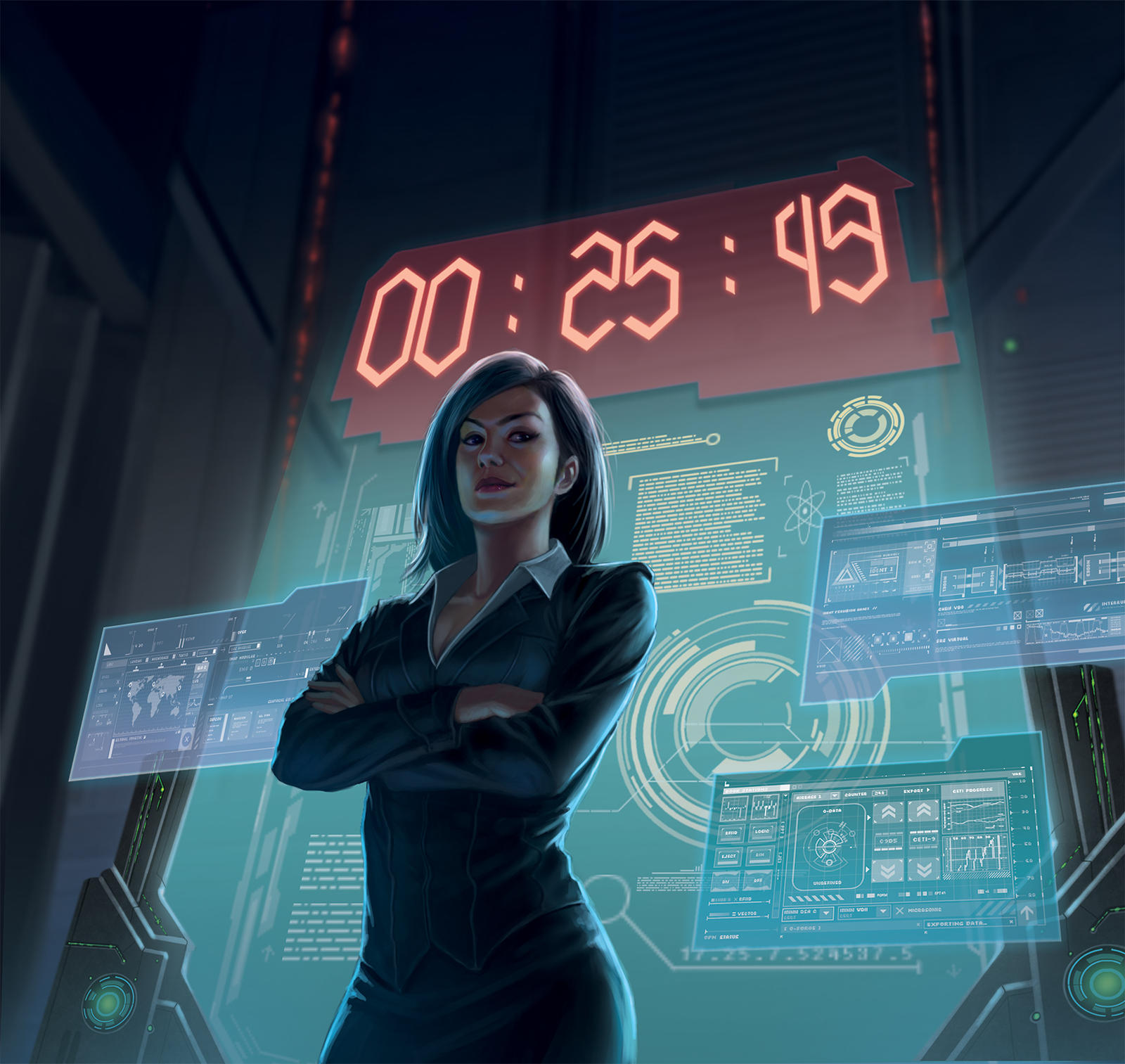
Well, got the final push to begin working again on the screamsheets I had in the oven.
Here goes Screamsheet nº 4
Its the first on a few one that should extend on drones. First one is mainly rules on how to operate them, detect, interfere or whatever. Its mostly a recompilation of rules on the official books, but this way it gets in a more accessible place.
And serves as a foundation for next screamsheets, so I don't have to tell what is a CCD or whatever.
Showing posts with label rules. Show all posts
2020-04-14
Screamsheet nº4 Drones, part 1/3 ?
2016-07-08
Customizing the characters
I've been brainstorming on a way to do Advantages/Disadvantages or feats or somewhat of that style.
My reasoning is simple ... I want characters to be more unique. For all the things that d20 does wrong, I like the "Feats" concept, in which you can make two identical warriors completely different with their feat list.
Other games does the same with perks or advantages you can chose on the character creation, giving him a special flavor. Which I don't always like because ... that kind of advantages usually can only be acquired during character creation, eliminating some kind of in-game progress.
Luckily - between implants and equipment - Cyberpunk gives plenty of options for customizing your character and make it stand from others. But when you play regularly with "strangers" in public games (or forum play) ... well, characters begin to resemble more and more (mechanically), as they go for the obvious/cliche choices.
However Advantages/Disadvantages have their own problems ... too often they are a simple collection of numbers that only serve to min/max character sheets without really adding any flavor to it.
The tough character is going to make himself tougher, the faster one will accumulate as many initiative modifiers as he can, etc, etc.
Also, a lot of players tend to chose disadvantages carefully, exploiting and planing on making the minor impact possible for the game.
So ... disadvantages? I think I would discard them. Your netrunner lost the leg in a gruesome accident? You're free to do it. Just don't expect something in return.
That leaves me with some sort of advantage/trait system to work with. Maybe something limited like "two traits perks per character".
But I wouldn't like those traits becoming simple numerical bonuses to skills ... they should be a little more complex and colorful. Numerical advantages tend to be forgotten during play unless a player min/max them unbalancing games.
So ... if you want a greater initiative, put more points into reflexes and buy some boostware, if you want to be a though guy, boost your BOD.
Which make those perks/advantages/traits harder to make :P
So far I failed to make a good list. They always end on the short side ... or uninspired. And, to be fair, if those perks aren't really "game changing" it's a bit of a dumb decision to add complexity to the game for the sake of doing it.
They have to be good enough to justify adding them ...
So, for now, I will continue to circle the idea like a vulture watching it's prey.
My reasoning is simple ... I want characters to be more unique. For all the things that d20 does wrong, I like the "Feats" concept, in which you can make two identical warriors completely different with their feat list.
Other games does the same with perks or advantages you can chose on the character creation, giving him a special flavor. Which I don't always like because ... that kind of advantages usually can only be acquired during character creation, eliminating some kind of in-game progress.
Luckily - between implants and equipment - Cyberpunk gives plenty of options for customizing your character and make it stand from others. But when you play regularly with "strangers" in public games (or forum play) ... well, characters begin to resemble more and more (mechanically), as they go for the obvious/cliche choices.
However Advantages/Disadvantages have their own problems ... too often they are a simple collection of numbers that only serve to min/max character sheets without really adding any flavor to it.
The tough character is going to make himself tougher, the faster one will accumulate as many initiative modifiers as he can, etc, etc.
Also, a lot of players tend to chose disadvantages carefully, exploiting and planing on making the minor impact possible for the game.
So ... disadvantages? I think I would discard them. Your netrunner lost the leg in a gruesome accident? You're free to do it. Just don't expect something in return.
That leaves me with some sort of advantage/trait system to work with. Maybe something limited like "two traits perks per character".
But I wouldn't like those traits becoming simple numerical bonuses to skills ... they should be a little more complex and colorful. Numerical advantages tend to be forgotten during play unless a player min/max them unbalancing games.
So ... if you want a greater initiative, put more points into reflexes and buy some boostware, if you want to be a though guy, boost your BOD.
Which make those perks/advantages/traits harder to make :P
So far I failed to make a good list. They always end on the short side ... or uninspired. And, to be fair, if those perks aren't really "game changing" it's a bit of a dumb decision to add complexity to the game for the sake of doing it.
They have to be good enough to justify adding them ...
So, for now, I will continue to circle the idea like a vulture watching it's prey.
2015-04-04
Creating an NPC repository
One of the things I would like to do is a PDF with a recollection of NPC for quick characters in a game or during it's preparation.
The idea comes from the Eclipse Phase NPC supplement which has saved me from more of one headache.
For Cyberpunk I could rely on the quick NPC generation from the core rulebook but it make random characters without any logic. And it doesn't even use any of the info on the splatbooks.
My template would be this:
And an example of a quick NPC would be like this:
Ideally I should make various levels of characters ... low level mobs, average opponents/allies, expert ones, etc. ... it's a lot of work, but well. It ain't gonna make itself, right?
Let's see if I have time to do it.
Edit: One year later ... no, I did not have the time :D that's life for you :P
The idea comes from the Eclipse Phase NPC supplement which has saved me from more of one headache.
For Cyberpunk I could rely on the quick NPC generation from the core rulebook but it make random characters without any logic. And it doesn't even use any of the info on the splatbooks.
My template would be this:
And an example of a quick NPC would be like this:
Ideally I should make various levels of characters ... low level mobs, average opponents/allies, expert ones, etc. ... it's a lot of work, but well. It ain't gonna make itself, right?
Let's see if I have time to do it.
Edit: One year later ... no, I did not have the time :D that's life for you :P
2015-04-02
Netrunning small revision
While my initial intention was to use the rules as they come in the basic manual for my latest forum games. I've finally decided to make some small adjustments and clarifications for my players to better suit my preferences.
Step 1: Preparing for the run
The first thing you need is a cyberterminal and some programs. If you miss one or both, you will not reach very far.
When you turn on the terminal and prepare to surf the net, the first thing you'll find is a virtual room off your own terminal. Here you can run your programs locally and specify the name/appearance you'll have once you're inside the net.
Step 2: Traveling on the global network
If you are already connected directly to the target network, you can skip this step.
To travel around the world you have to go through a number of main nodes/proxies. Those are usually in major cities and are often in freely available public lists. However, each node keeps track of your path through the network to inform any tracking program where you come from.
If you want to avoid leaving a trace around the net (that correspond with your real world position, remember I-G algorithms) you have to bypass their security protocols. It's not a very difficult thing to do, but as you reroute signals and stack fake IDs, it slows down your connection.
Each node has a value of "trace" and one of "security" (as always). The former adds to the difficulty of tracking you, the sum of the second divided by two is a penalty of your initiative rolls.
Ex .: If you pass by Night City, Los Angeles, Mexico City, Panama City and City of Bogotá, you'll have a trace value of 13 and a -4 penalty to initiative (7 divided by 2).
Step 3: Infiltration
Once you've reached your goal, you must get into the data fortress and execute your malware ... of which there are plenty.
While you're out of it inoffensively, the system will ignore you. But the moment you start an attack, the system will defend against you (or will send the sysop a notice of your presence). It will be time to throw initiatives and move by turns ... you'll better have Stealth programs to hide or you will understand why runners fear black ice.
Typical checks on the net are:
The STR refers to the strength of the attacking or defending program. If for example you want to hide, you'll need to use programs to mask your signal or hide your ID and beat the system detection programs (like the Dog series).
If the opponent (either an AI or sysop) is aware of your presence, it can attack you freely. If not it will have to locate you first even if your are running mayhem in their system ... or in a desperate act, they can cut external communications or reboot the system.
To be able to FIND, READ, EDIT, COPY and DELETE data from a data fortress, you first have to overcome their defenses (Data Walls or Code Gates) with appropriate anti-system programs (such as Drill). If you leave the fort and the administrator becomes aware of the security breach, they will be restored.
Step 4: Exit
Once you've finished with your work, you just have to leave to other areas of the net or disconnect (with a roll of 8 or more with a d10).
Notes:
If you have broken through a data fortress Data Walls or Code Gates, you do not need a test to control remote computer (but you still need the program!).
Without programs you cannot manipulate the net, but you can still browse it, manually interact with Code Gates and access unprotected memory blocks. If you know someone you my try to acquire programs from them or reach Netrunner hubs in the search of a kind soul.
Also, keep in mind that most of Datafortress have public zones where it is not necessary to make a raid to access it. In them you can typically find all kinds of contact information, products or organize meetings.
Step 1: Preparing for the runThe first thing you need is a cyberterminal and some programs. If you miss one or both, you will not reach very far.
When you turn on the terminal and prepare to surf the net, the first thing you'll find is a virtual room off your own terminal. Here you can run your programs locally and specify the name/appearance you'll have once you're inside the net.
Step 2: Traveling on the global network
If you are already connected directly to the target network, you can skip this step.
To travel around the world you have to go through a number of main nodes/proxies. Those are usually in major cities and are often in freely available public lists. However, each node keeps track of your path through the network to inform any tracking program where you come from.
If you want to avoid leaving a trace around the net (that correspond with your real world position, remember I-G algorithms) you have to bypass their security protocols. It's not a very difficult thing to do, but as you reroute signals and stack fake IDs, it slows down your connection.
Each node has a value of "trace" and one of "security" (as always). The former adds to the difficulty of tracking you, the sum of the second divided by two is a penalty of your initiative rolls.
Ex .: If you pass by Night City, Los Angeles, Mexico City, Panama City and City of Bogotá, you'll have a trace value of 13 and a -4 penalty to initiative (7 divided by 2).
Step 3: Infiltration
Once you've reached your goal, you must get into the data fortress and execute your malware ... of which there are plenty.
While you're out of it inoffensively, the system will ignore you. But the moment you start an attack, the system will defend against you (or will send the sysop a notice of your presence). It will be time to throw initiatives and move by turns ... you'll better have Stealth programs to hide or you will understand why runners fear black ice.
Typical checks on the net are:
| Initiative: REF + speed + 1d10 terminal. | |
| Stealth and evasion: 1d10 + prog. STR | Difficulty: 6 + Detection prog. STR. |
| Anti-system attacks: 1d10 + prog. STR | Difficulty: 6 + Data Wall or Code Gate STR. |
| Anti-personnel attacks: 1d10 + prog. STR + INT + Interface. | Difficulty: 6 + prog. STR + INT + Interface. |
| Anti-software attacks: 1d10 + prog. STR + INT + Interface. | Difficulty: 6 + prog. STR + INT + Interface. |
| Drivers and utilities: 1d10 + prog. STR | Difficulty: 6 + Data Wall STR. |
The STR refers to the strength of the attacking or defending program. If for example you want to hide, you'll need to use programs to mask your signal or hide your ID and beat the system detection programs (like the Dog series).If the opponent (either an AI or sysop) is aware of your presence, it can attack you freely. If not it will have to locate you first even if your are running mayhem in their system ... or in a desperate act, they can cut external communications or reboot the system.
To be able to FIND, READ, EDIT, COPY and DELETE data from a data fortress, you first have to overcome their defenses (Data Walls or Code Gates) with appropriate anti-system programs (such as Drill). If you leave the fort and the administrator becomes aware of the security breach, they will be restored.
Step 4: Exit
Once you've finished with your work, you just have to leave to other areas of the net or disconnect (with a roll of 8 or more with a d10).
Notes:
If you have broken through a data fortress Data Walls or Code Gates, you do not need a test to control remote computer (but you still need the program!).
Without programs you cannot manipulate the net, but you can still browse it, manually interact with Code Gates and access unprotected memory blocks. If you know someone you my try to acquire programs from them or reach Netrunner hubs in the search of a kind soul.
Also, keep in mind that most of Datafortress have public zones where it is not necessary to make a raid to access it. In them you can typically find all kinds of contact information, products or organize meetings.
2014-06-02
This one is about netrunning and long distance links.
While it wasn't apparent years ago when the rules were created, the thing is that travelling around the net in the search of info and social media isn't more costly than keeping on your local area. After all we aren't exactly using modems of old calling to specific numbers around the world.
So we can simply ditch the LDL rules about costing money ... but we still need tracing values.
My take on the issue (which I've been mumbling about for a while) is the following.
Each Node (or LDL) is considered a Proxy who transmits data to the rest of the world. Proxies can limit incoming data so countries can ban certain sites/zones (like social media during revolts, or other political sensible content).
The problem is that proxies tend to log every visit ... and usually, netrunners don't want to be traced.
Each times a netrunner pass through a proxy without being logged on, he adds half the security value as a penalizer to his Initiative. So if he goes through:
While it wasn't apparent years ago when the rules were created, the thing is that travelling around the net in the search of info and social media isn't more costly than keeping on your local area. After all we aren't exactly using modems of old calling to specific numbers around the world.
So we can simply ditch the LDL rules about costing money ... but we still need tracing values.
My take on the issue (which I've been mumbling about for a while) is the following.
Each Node (or LDL) is considered a Proxy who transmits data to the rest of the world. Proxies can limit incoming data so countries can ban certain sites/zones (like social media during revolts, or other political sensible content).
The problem is that proxies tend to log every visit ... and usually, netrunners don't want to be traced.
Each times a netrunner pass through a proxy without being logged on, he adds half the security value as a penalizer to his Initiative. So if he goes through:
- Night City (T2 S2)
- Los Angeles (T2 S2)
- Mexico City (T2 S1)
- Panama City (T3 S1)
- Bogota City (T4 S1)
He would accumulate a trace value of 13 and a security value of 7 (-3 to Initiative).
Of course, you can buy a prepaid SIM card (10 to 30 credits) for your cyberdeck and throw it after the run making sure no one knows who you are. Just remember, if someone trace you - thanks to I-G algorithms - they know where you are in the Real Space.
So ... try to hack from a secure/anonymous place, will you?.
We have started playing the Land of the Free module for Cyberpunk with my game group. It all begun as a forum game but quickly developed to real world sessions as we finished our Edge of the Empire introductory module.
The first part, Adriana extraction, was smooth ... maybe to smooth (thanks to the Netrunner). After the game I thought of a dozen ways to spice up that session but, alas, it was too late. I been out of "real space" DMing for quite a long time and I find myself a bit rusty doing it.
But anyways, I've returned to directing Cyberpunk 2020 and that's what matters.
At the same time, Watch Dogs have been released and I have been having some fun with it ... one of the main tools the protagonist (Aiden Pearce) uses is a mobile phone which he uses to hack remote operated machines.
I been thinking if it was possible to do the same in Cyberpunk ... yes, it can be done.
Let's take a look into it, but take into account that those rules are not mine, most of them comes from Rache Bartmoss Guide to the Net.
First, you need to program a new interface since you won't use normal I-G algorithms (Very difficult task on Programming skill or Difficult task on Expert:Complex Computer Language). Or modify standard modem routines to handle cyberdeck programs (Difficult or Average task, same skills).
Alternatively, someone else can do it for you for a 150-200 credits fee.
As we don't plan to netrun with a little pocket PC, we don't need to make further change to it's programs or interface. Which means we are ready to go and wreak some havoc.
Heres a completely illegal piece of hardware already rigged for remote controlling:
- Zetatech "E-Book" Microcomp (1CPU, 1INT, 12 MU with a 15.4cmx7.6cmx1.3cm size) 100cr
- Cellular upgrade (similar to the Cybermodem Interface) +500cr
- Custom netrunning interface +200cr
- Crystal ball (4STR, 1MU) 140cr
- Dee-2 (3STR, 1MU) 130cr
- Genie (5STR, 1MU) 150cr
- Hotwire (3STR, 1MU) 130cr
- News at 8 (4STR, 1MU) 140cr
- Soundmachine (4STR, 1MU) 140cr
- Terminator (4STR, 2MU) 260cr
- Phone Home (2/5STR, 1UM)150cr
Which amounts to 2040cr ... but remember, its illegal, so the price should be more like 4000cr
It's debatable if PDA and Microcomps should already have cellular SIMs and ports. When Cyberpunk was created the FAX was the tool of the future ... but they have become little more than a gimmick while most people simply send e-mail/documentation from his portable smartphone or paper thin tabletops with more processing power than old mainframes and access to cloud databases that extend far and beyond.
Even the pay per time travelled on the net and it's LDC seem obsolete in the face of the networks and competing corps trying to offer the best and cheapest way to connect around the world.
So our generic Zetatech clone smartphone (1CPU, 1INT, 10MU) should cost around 200 or 300 credits, while the top of the line models (1CPU, 2INT, 20MU) should be around 500 or 600 cr.
Also, we need to put a bit of attention to Remotes and its accessibility ... should any hacker wannabe walk nearby to an Arasaka building and take a sneak peek over its camera system?
When letting players (and NPC) use his remote hacking tools make yourself a question ... is that remote inside a datafortress?
- Is a robotaxi behind a datawall? Most probably, not.
- Is a Dataterm behind a datawall? Surely not.
- Is an Arasaka camera behind a datawall? Yes, you can bet about it.
- Are public traffic cams behind datawalls? Nope.
To control a remote behind a datafortress you will need to gain access to it. You can wreak it's datawalls previously (but they will repair them in a small amount of time) or you can brute hack the Codegate to attain the password (but most datafortress change it's passwords periodically).
The better way to do it, is to assault a datafortress, get inside, access to the users database, and add a new user for you and leave before somebody notices you and could suspect something. Until someone supect that account is compromised, your safe to go.
Once you have a way around the datawalls you can use the remote tools freely.
2012-09-12
New Cyberware
The following implants and chips where made trying to update the feeling of the setting to more a modern standards. It also serves as a preparation for netrunning other people brains, or ghosting if you prefer.
Remember that a character can only use as many chips as his INT score, every MU of his spider processor counts as a chip. Spider processors cannot be used for netrunning, you still need a cyberdeck.
CP2020 - House Rules - Neural & Chipware
2012-09-09
Humanity loss alternate rules
One of my gripes with the humanity rules, is that they are a little bit punishing on the roleplaying side. While I understand its motives, I like to play more cyberized games and having PC and NPC with low EMP make for rather boring encounters.
The following rules add a bit of variety to mental disorders and let players choose how it affect his character.
Humanity Loss Alternate Rules
The following rules add a bit of variety to mental disorders and let players choose how it affect his character.
Humanity Loss Alternate Rules
2011-12-14
Martial Arts
Later I will try to expand on this, but for now I want to write some concerns about martial arts and non martial arts.
There are a few skills I find poorly conceived.
Brawling, Melee, Fencing and Martial Arts ... on one side we have the enormous difference between Brawling and Martial Arts ... on the other the inexistent difference between Melee and Fencing.
As a Skill Brawling is quite mediocre, even easy MA are fairly superior to it and cost the same to learn. Meanwhile, Melee and Fencing doesn't even have a difference apart from name (and ignoring the optional rule from the GM guide).
My proposal is to convert Fencing to a martial arts (Pacific Rim style) so swords become more fearsome and Fencing more useful.
And merging Brawling with Melee ... so maybe you cannot do the same damage, but at least you can fight with anything that comes to your hands.
There are a few skills I find poorly conceived.
Brawling, Melee, Fencing and Martial Arts ... on one side we have the enormous difference between Brawling and Martial Arts ... on the other the inexistent difference between Melee and Fencing.
As a Skill Brawling is quite mediocre, even easy MA are fairly superior to it and cost the same to learn. Meanwhile, Melee and Fencing doesn't even have a difference apart from name (and ignoring the optional rule from the GM guide).
My proposal is to convert Fencing to a martial arts (Pacific Rim style) so swords become more fearsome and Fencing more useful.
And merging Brawling with Melee ... so maybe you cannot do the same damage, but at least you can fight with anything that comes to your hands.
2011-12-02
Wireless plugs
So let's begin ...
Technology wise, it my seem strange that in a not to far future people plug to his gadgets (guns, cars, etc) ... and it is. So ...
Wireless switch - Surg:N - Cost:100ed - H.L.:1
This implant let you connect wirelessly to any device prepared for it (50-500ed). The Wireless Switch must be used in along an appropriate link (cybermodem, vehicle, smartgun, etc) and have a 5m range.
That's all? Not exactly. This technology is useful for the average Joe, but anybody who expect to be in daily firefights would be wiser to pack old interface plugs. "Why?" you should ask. Because wireless signals can be disrupted, or worse, hacked.
Signal disrupter - Cost 295ed
This small gadget (the size of and old PDA) has the capability to disrupt signals in a 30m radius. His rechargeable batteries last for 3 hours of continual use. Ideal to disable phones on theaters, cinemas and the like.
Hacking a wireless connection.
Now, you are wondering how you can hack a wireless smartgun or smartcar. It's quite easy, really.
You will need to locate wireless spots (LOCATE REMOTE), sniff the wireless signals, decrypt them and fake them so the device believes you are the legitimate proprietary. Or you could assault it's datawalls and the use a CONTROL REMOTE command.
To sniff signals you need a specialized program, and have to succeed in a STR test (1D10 <= Program STR), then you need to decrypt the acquired data as usual, finally fake the signal with another specialized program and succeed on an opposed test (1d10+Attack STR vs 1d10+Defense INT).
Programs:
Sniffer v1 - STR 3; UM 1; Cost 300ed
Sniffer v2 - STR 5; UM 2; Cost 500ed
Signal faker v1 - STR 3; UM 2; Cost 400ed
Signal faker v2 - STR 4; UM 3; Cost 600ed
Signal faker v3 - STR 5; UM 4; Cost 850ed
To randomly determine the defenses of a wireless ready item, roll 1d6+2+nº CPU as the Datawall STR. Most wireless apparels use a single CPU to manage the comunication between devices, so it's INT is +3. Secure devices use more than one CPU, strengthening it's defenses and improving it's capabilities.
So ... wireless things not that cool anymore, uh?
Technology wise, it my seem strange that in a not to far future people plug to his gadgets (guns, cars, etc) ... and it is. So ...
Wireless switch - Surg:N - Cost:100ed - H.L.:1
This implant let you connect wirelessly to any device prepared for it (50-500ed). The Wireless Switch must be used in along an appropriate link (cybermodem, vehicle, smartgun, etc) and have a 5m range.
That's all? Not exactly. This technology is useful for the average Joe, but anybody who expect to be in daily firefights would be wiser to pack old interface plugs. "Why?" you should ask. Because wireless signals can be disrupted, or worse, hacked.
Signal disrupter - Cost 295ed
This small gadget (the size of and old PDA) has the capability to disrupt signals in a 30m radius. His rechargeable batteries last for 3 hours of continual use. Ideal to disable phones on theaters, cinemas and the like.
Hacking a wireless connection.
Now, you are wondering how you can hack a wireless smartgun or smartcar. It's quite easy, really.
You will need to locate wireless spots (LOCATE REMOTE), sniff the wireless signals, decrypt them and fake them so the device believes you are the legitimate proprietary. Or you could assault it's datawalls and the use a CONTROL REMOTE command.
To sniff signals you need a specialized program, and have to succeed in a STR test (1D10 <= Program STR), then you need to decrypt the acquired data as usual, finally fake the signal with another specialized program and succeed on an opposed test (1d10+Attack STR vs 1d10+Defense INT).
Programs:
Sniffer v1 - STR 3; UM 1; Cost 300ed
Sniffer v2 - STR 5; UM 2; Cost 500ed
Signal faker v1 - STR 3; UM 2; Cost 400ed
Signal faker v2 - STR 4; UM 3; Cost 600ed
Signal faker v3 - STR 5; UM 4; Cost 850ed
To randomly determine the defenses of a wireless ready item, roll 1d6+2+nº CPU as the Datawall STR. Most wireless apparels use a single CPU to manage the comunication between devices, so it's INT is +3. Secure devices use more than one CPU, strengthening it's defenses and improving it's capabilities.
So ... wireless things not that cool anymore, uh?
Subscribe to:
Posts (Atom)